

the idea
HOW IT ALL STARTED
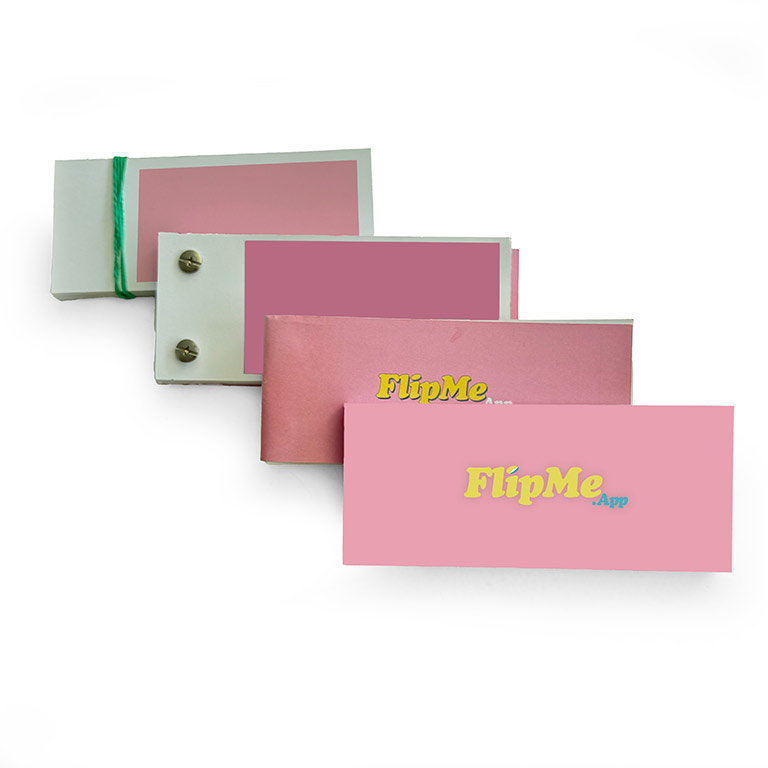
Ever since I was a child, flipbooks have fascinated me. I still vividly remember sitting in my room for hours, flipping through them back and forth, mesmerized by the tiny animations. Every visit to the bookstore had me searching for new ones, but unfortunately, they were rare, and my collection remained small.
Many years later, after completing my graphic design studies, I found myself working on stop-motion animations for an advertising agency. It instantly took me back to my childhood and those beloved flipbooks. That’s when I discovered how to extract image sequences from short video clips to create my own flipbooks. I made a few for family and friends, and to my surprise, most of them had almost forgotten about these little gems. The best part? Seeing their faces light up as memories came rushing back while they flipped through the pages. Those moments of curiosity and delight have been the most rewarding part of this journey.
Even in the age of social media, flipbooks still captivate people—especially kids. And that’s when I knew:
It’s time for a flipbook comeback!
THE PROBLEM
The more flipbooks I gave away, the more people wanted one. And they all had one thing in common: they captured moments that should never be forgotten.
“Can I get a flipbook of our wedding? … My child’s first steps? … Our grand opening party? … Moving day? … Our holiday trip?” The requests kept coming, and the possibilities seemed endless. People often asked how I created these flipbooks, and I tried my best to explain. But as I walked them through the process, I realized that without any graphic design experience, most had no chance of making one themselves.
That’s when I saw the real challenge: How can video clips be processed easily to extract the perfect sequence of pages?
THE SOLUTION
A few years later, while working as a UI/UX designer at a software agency, one of my daily tasks was simplifying complex processes – exactly what I needed for my flipbook project!
How cool would it be if anyone with a smartphone could create their own flipbook in seconds?!
And so, the idea for an app was born.
I shared the concept with a developer at the agency, and his response was surprisingly simple:
“Every video is just a series of images played in sequence. All the app needs to do is count the frames and divide the total by, say, 50 to set the intervals. A short video will create a smooth animation, while a longer video will be choppier since the frames are spaced out more. Finally, the app compiles the 50 selected frames into a printable PDF, which is then sent to a server for printing.”
He had basically described exactly what I had been doing manually all this time. And now, it could all be automated with a mobile app! I imagined the endless flipbook possibilities—suddenly, the tedious, frame-by-frame editing process wouldn’t just be for video editors and graphic designers anymore. All you’d need is a short video clip and a defined start and end point.
Curious to see if such an app already existed, I did some research. To this day, I haven’t found anything quite like it. So, I started sketching wireframes and built a prototype.